
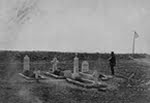

"The Crimean is today less compelling, and the generic conventions Fenton used to naturalize the scenes of war seem contrived or empty. The very conventions that make these photographs difficult for us to read, were, however, what made them appealing to a Victorian audience that desired to possess history." The Crimean photograph above is a perfect example of what Natalie Houston was talking about in her article, as if definitely appears to be staged in some way. I mean, the gentleman pictured in Fenton's "The Artist's Van" is sitting perfectly stoic on a wagon that is being led my nothing. So he's just sittin' there, staring blankly into space. Sure, it's artistic, and I'm sure at the time it was taken that this type of photograph was all the rage, but I definitely feel the loss that Houston discussed in her article. If the audience isn't able to decipher the purpose of the picture, then how are they able to appreciate it?
Houston claims that "By focusing on the officers and portraying them in this stylized manner, the real hardships faced by the troops are minimized, suggesting perhaps Fenton’s political acquiescence to his Royal sponsor. " I get that he couldn't get a clear shot if people didn't stand still, but the fact that a good chunk of the people in the photos are in clean, pressed uniforms doesn't make it seem like there's a war going on. His style is extremely Victorian, very formal, and while he at least gives recognition to those who were there, the rules that prohibited him ends up devaluing the experience of the soldiers. By not being able to capture images of dead bodies (as horrible as that sounds) and technology restricting his ability to capture battle scenes, without a written explanation of things we would never really get the whole picture.
Houston points out that "The primary function of Fenton’s photographs was to memorialize and record that which was already known, rather than to present something new." This technology was so new, they knew the limits. They were there simply to record, to capture even the smallest piece of the souls of the men who were there, and now we have teh history to prove it. Are they staged? For sure. Are they realistic to the settings? Not really. But did each of the men photographed serve their country? Absolutely. And I suppose that's what counts.


